


Stemcell Science Shop
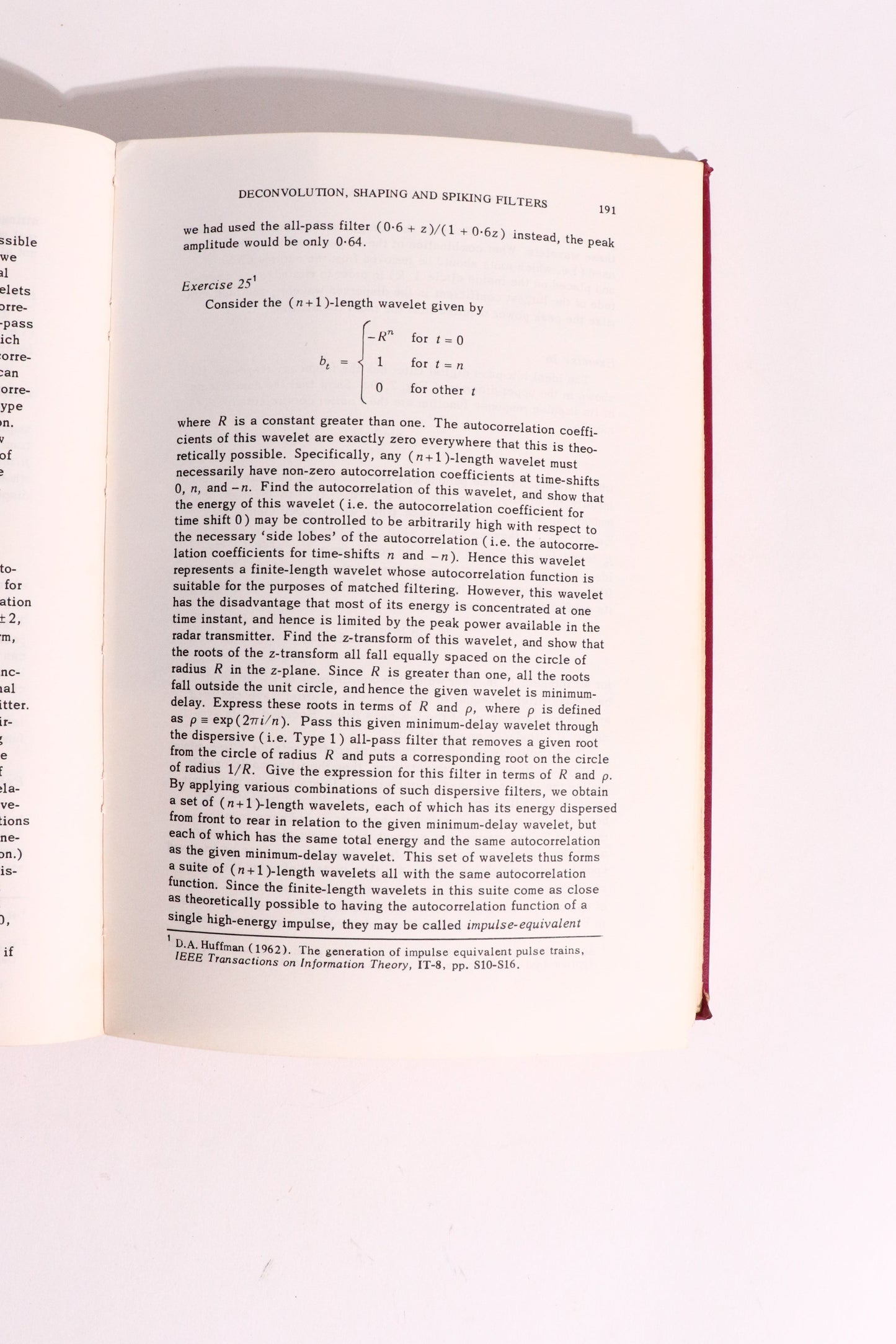
Statistical Communication and Detection: Digital Processing of Radar & Seismic Signals — Enders A. Robinson, First Edition / U.S. Issue (1967)
Statistical Communication and Detection: Digital Processing of Radar & Seismic Signals — Enders A. Robinson, First Edition / U.S. Issue (1967)
Impossible de charger la disponibilité du service de retrait
A first-edition 1967 U.S. issue of Enders A. Robinson’s Statistical Communication and Detection, with Special Reference to Digital Data Processing of Radar and Seismic Signals, an important early technical work in the development of digital signal processing and computational geophysics.
Published at a moment when digital computers were only beginning to become practical tools for processing large quantities of scientific data, Robinson’s book applies statistical communication theory to two fields built around extracting weak information from noisy signals: radar and reflection seismology.
The book develops mathematical and computational techniques for detecting, filtering, predicting, and reconstructing signals, with extensive treatment of topics including correlation, prediction, digital filtering, deconvolution, wavelets, noise, radar detection, seismic traces, spectral analysis, shaping filters, spiking filters, and the z-transform.
Its historical importance is closely tied to Robinson himself. Beginning at MIT in the early 1950s, Robinson helped develop the seismic convolutional model and statistical deconvolution techniques that allowed geophysicists to mathematically separate the seismic wavelet from reflections generated by underground geological layers. These methods became fundamental to digital seismic processing. In Robinson’s own historical account, his group was running deconvolution programs on MIT’s Whirlwind computer as early as 1952, years before digital processing became routine in the petroleum industry.
By the mid-1960s—the exact period in which this book appeared—commercial geophysical companies were beginning to offer digital deconvolution as a practical service. Robinson later described approximately 1964–1967 as the period when the technique moved from specialized in-house work into broader commercial use, making this 1967 volume essentially contemporary with that transition.
The connection between radar and seismic processing is also historically revealing. Both are reflection problems: a transmitted signal interacts with a distant target or underground structure and returns carrying information obscured by noise and distortion. Robinson helped show that statistical and digital techniques developed in communications and radar could be applied to the interpretation of the Earth.
His contributions were subsequently recognized with major honors, including the Society of Exploration Geophysicists’ 1969 award for contributions to digital seismic processing and election to the National Academy of Engineering in 1988 for pioneering contributions to digital seismic processing.
The book remains a useful artifact from the formative period of digital signal processing, when techniques now implemented instantly in software still represented cutting-edge combinations of mathematics, electronics, computing, and geophysics.
Author: Enders A. Robinson
Forewords: Markus Båth and Anthony F. Gangi
Publisher: Hafner Publishing Company, New York
Copyright: Charles Griffin & Company Ltd., London
Year: 1967
Edition: First Edition, U.S. issue
Pages: xvii + 362
Format: Hardcover
Condition: Vintage hardcover in red boards. This copy has substantial spine damage, including extensive loss and separation of the spine covering, exposed underlying binding material, old tape repairs, and considerable wear at the spine ends and joints. Boards show additional rubbing and edge wear. Interior pages shown appear complete, clean, and readily legible with normal age toning. This should be sold as a reading/reference or historical copy rather than a collectible-condition example. See photos for exact condition.
Shipping
Shipping
USA DOMESTIC SHIPPING
We offer standard shipping (5–9 business days) on all U.S. orders.
CANADIAN SHIPPING
Orders within Canada typically arrive within 3–7 business days. Please note that depending on the product or supplier, customs or duties may apply.
INTERNATIONAL SHIPPING
We offer standard international shipping (2–6 weeks). Import duties, taxes, and charges are not included in the item price or shipping cost. These charges are the buyer's responsibility and may vary by country.
Hassle-Free Returns
Hassle-Free Returns
We hope you love what you ordered! If something isn’t quite right, whether it’s the size, color, or simply not what you expected, feel free to reach out.
Returns and exchanges are handled according to our policy, which may vary depending on the product. You can review all the details here.
If you have any concerns or would like to discuss an exchange, don’t hesitate to contact us, we’re happy to help.
Our goal is complete customer satisfaction.



Shop with Purpose
OSADIA is a Spanish word that means "audacity." We believe this word reflects the unique journey and stories behind our products, those stories are all about hard work, courage and resilience. In Osadía you will find unique fair trade, handmade & socially responsible products, every product is empowering artisans, small businesses and vulnerable communities around the world.